





Table of Contents
- Fabric Quality and Fiber Composition: The First Test
- How to Check Fabric Quality in 60 Seconds
- Clothing Construction Basics: Stitching and Seams
- The Touch and Feel Test: Hand Feel, Drape, and Weight
- Hardware, Buttonholes, and Pattern Matching
- Colorfastness and Dyeing Techniques That Last
- Durable Clothing for Kids: What to Look For
- Price vs. Quality: The Cost Per Wear Reality
- Frequently Asked Questions
Last Updated: September 9, 2026
Shopping for clothes online can feel like a gamble. Understanding the signs of high quality boutique clothing separates a wardrobe staple from a one-wear disappointment. At Hot Possessions & Glitter Girls, we offer a vast selection of over 4,000 apparel items, so we handle enough fabric to know what separates a genuine find from fast fashion filler. High quality boutique clothing is defined by its construction, fiber content, and detailing rather than its price tag alone. Below are the checks you can run to verify quality before you buy.

Fabric Quality and Fiber Composition: The First Test
The fiber content label tells you more than any marketing copy ever will. Natural fibers like cotton, linen, and wool breathe well and age gracefully, while synthetic blends add durability and stretch. Look for a balance: a cotton-spandex blend offers comfort without sacrificing shape retention.
A garment labeled mostly polyester traps heat and pills quickly, while 100 percent natural fibers wrinkle easily. The sweet spot is a natural-dominant blend with a small synthetic percentage for structure. Clear fiber content listing signals a maker confident in the materials.
How to Check Fabric Quality in 60 Seconds
Hold the fabric up to a light source; if you can see through it easily, the weave is too loose. Pinch a section and rub it together. Quality fabric resists pilling and feels substantial, not papery.
Gently pull the fabric horizontally and vertically; it should recover its shape without sagging. Heavier fabrics, measured in grams per square meter, generally indicate more durability. High-quality fabric falls smoothly and follows the body's movement, whereas stiff, low-grade material stands away awkwardly.
Clothing Construction Basics: Stitching and Seams
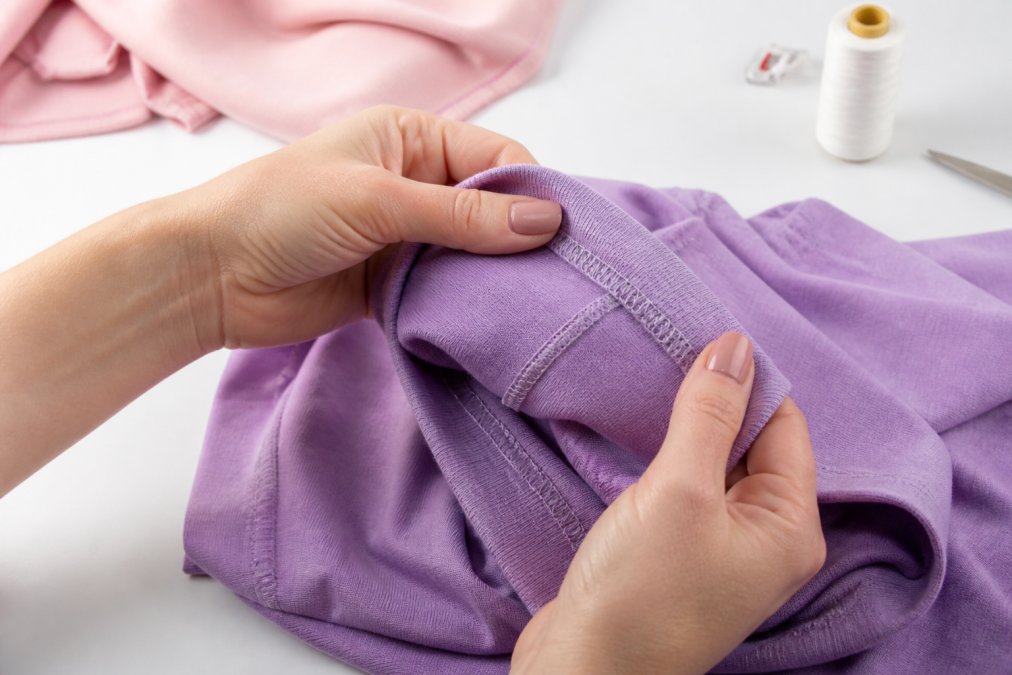
Turn the garment inside out and inspect the seams. High quality boutique clothing features consistent, tight stitching without loose threads or skipped stitches. Look for a seam allowance of at least half an inch; this allows for alterations and prevents the seam from pulling apart.
Serged seams, which use an overlock stitch to bind raw edges, resist fraying. Double stitching on stress points like shoulders and crotch seams provides reinforcement where garments typically fail first. A single, straight stitch that puckers or gaps signals a piece that won't survive repeated washing.
The Touch and Feel Test: Hand Feel, Drape, and Weight
Hand feel refers to the texture of the fabric against your skin; quality materials feel smooth, soft, or intentionally textured, never rough or plasticky. Drape describes how the fabric hangs on the body, following natural curves without clinging or standing stiff.
A mid-weight knit offers structure without bulk, while a heavy ponte fabric holds its shape through a full day of wear. Hold the garment up by the shoulders and watch how it settles; quality fabric moves fluidly and returns to its resting shape. If the material feels flimsy or shows visible stretching, walk away.
Hardware, Buttonholes, and Pattern Matching
Buttons, zippers, snaps, and hooks carry real mechanical stress every time you dress and undress. Here is what separates hardware that lasts five years from hardware that fails in five wears.
Buttons: Material, Anchoring, and Shank Design
Quality garments use buttons made from natural materials like corozo nut, tagua nut, mother-of-pearl, or genuine horn, which resist chipping and develop a patina with age. Plastic buttons, especially injection-molded ones with visible seams, crack at the center hole under repeated stress.
A quality garment uses a thread shank, a small gap between the button and the fabric created by wrapping thread around the base during sewing. This gap accommodates the thickness of the buttonhole layer, preventing strain on the fabric. On a flat, tightly-sewn button with no shank, the fabric around the buttonhole will distort and tear within months.
For metal buttons on denim or workwear, check the backside. Quality riveted buttons show a clean, flush backing. Cheap pressed buttons often have sharp edges on the reverse that abrade the fabric underneath.
Zippers: Tracks, Pulls, and Tape Construction
Quality zippers use molded polyester teeth or metal teeth (brass, nickel, or aluminum) (ykk.com). Molded nylon coil zippers are acceptable on sportswear when the coil is tightly wound and the slider moves without catching.
Pinch the zipper track between your thumb and forefinger and run your fingers along its full length. The teeth should feel uniform with no gaps, bends, or missing links. A wavy track indicates poor manufacturing tolerances and will snag within weeks.
Quality sliders are self-locking, they hold the zipper in place when you release the pull. Test this by zipping a jacket halfway and tugging downward on the pull; a quality slider resists movement. Cheap sliders drift open, which is why cheap jackets gape at the chest.
Branded zippers from YKK, Riri, Lampo, and Talon are common markers of quality, but branding alone is insufficient. The real test is the tape, the fabric strip the teeth are sewn to. Quality zipper tape is densely woven and does not stretch when pulled; stretchy tape causes the zipper to buckle and separate from the garment.
Snaps, Hooks, and Eyelets
Snaps should require a firm, deliberate press to close and a clean pop to open. Quality snaps are made of brass or stainless steel with a corrosion-resistant finish. Check the backside, the post should be flush with the fabric, not protruding where it can scratch skin.
Hook-and-eye closures on skirts and trousers should be securely bar-tacked (reinforced with dense zigzag stitching) at both ends. A single straight stitch holding a hook will pull loose within ten wears.
Buttonholes: The Telltale Sign of Production Method
Quality garments feature buttonholes with dense, uniform stitching and cleanly cut openings with no loose threads inside. Run your pinky finger through the buttonhole; the interior should feel smooth, not rough or frayed.
Keyhole buttonholes, wider at one end to accommodate the button shank, appear on tailored jackets and coats, signaling higher production investment. Quality buttonholes run 20 or more stitches per inch, while cheap ones run 10 to 12 and unravel quickly (fashiondex.com).
Pattern Matching: The Geometry of Quality
On plaid, striped, houndstooth, or large-scale prints, the pattern should continue seamlessly across seam lines. This requires cutting each panel from the same position on the fabric bolt, which wastes material and increases cost. Mass-produced garments skip this step to maximize fabric yield, resulting in patterns that shift at the shoulders, side seams, and plackets.
Check the shoulder seam where the front and back panels meet, the side seams under the arms, and the center front placket on button-down shirts. On a quality garment, horizontal stripes align across these junctions.
Pattern matching matters most on plaid jackets and skirts, where mismatch is immediately visible. A garment with matched patterns at the shoulders and side seams signals a maker willing to absorb extra fabric cost for visual integrity.
Interfacing and Structural Support
Interfacing is the hidden layer of fabric fused or sewn inside collars, cuffs, waistbands, and plackets to give them structure. Quality garments use woven fusible interfacing that moves with the fabric. Cheap garments use non-woven interfacing that feels stiff and papery, and it delaminates, bubbles and peels away from the outer fabric, after the first wash.
Fold the collar and waistband. A quality collar springs back to its shape; a cheap one stays creased. If you feel a plastic-like layer separating from the outer fabric, the interfacing is failing. This defect cannot be repaired, only replaced, and it is one of the fastest ways to identify a garment that will not survive its second season.
The 90-Second Hardware Inspection
Here is a practical routine you can run in a store or at a thrift shop:
- Unbutton and rebutton every button. Note any that resist or feel loose.
- Zip and unzip every zipper three times, listening for grinding or catching.
- Run your finger along every seam where hardware attaches to check for loose threads or gaps.
- Fold the collar and waistband, then release, to test interfacing memory.
- Hold patterned fabric up to a mirror or flat surface to check alignment at the seams.
This routine takes under two minutes and catches the majority of construction defects that lead to premature failure.
Colorfastness and Dyeing Techniques That Last
Colorfastness is the fabric's ability to resist fading and bleeding when exposed to water and detergent. Deep, saturated dyes applied through quality processes hold their hue, while cheap dye jobs leave excess color that runs in the first rinse.
Dampen a white cloth and press it against a hidden seam or hem. If color transfers, the dye is unstable. Dark garments, especially denim and deep jewel tones, require extra scrutiny because they show fading most quickly. Garments labeled as garment-dyed or piece-dyed often produce richer, more even color.
Durable Clothing for Kids: What to Look For
Children's clothing faces a tougher test than adult wear: playgrounds, spills, and daily washing. Durable clothing for kids demands reinforced knees, double-stitched hems, and fabrics that withstand frequent laundering. Look for knits with good recovery that won't bag out at the elbows, and avoid delicate trims that catch on playground equipment.
The same quality markers apply, but they matter more. Check that elastic waistbands retain their snap, and inspect inside seams for rough edges that could irritate sensitive skin. For girls' boutique pieces, stones should be firmly set with no loose gaps. A well-made children's garment survives hand-me-downs, the ultimate test of construction.
Price vs. Quality: The Cost Per Wear Reality
The cost-per-wear calculation is a useful starting point, but it misses the two factors that actually determine whether a garment is worth its price: where it was made and whether it can be repaired. Price alone never tells you about construction quality.
What the Price Actually Pays For
When you pay for a boutique blouse, that money is distributed across fabric, labor, overhead, shipping, and retail markup. The price tag does not tell you which scenario you are in.
The price tag does not tell you which scenario you are in.
Verifying Ethical Manufacturing Claims
GOTS (Global Organic Textile Standard) certifies that a garment contains at least 70 percent certified organic fibers and that the entire supply chain, from harvesting to finishing, meets environmental and social criteria. Look for the GOTS logo on the care label or hangtag, then verify the certificate number on the GOTS public database.
OEKO-TEX Standard 100 certifies that a garment has been tested for harmful substances like formaldehyde, heavy metals, and restricted azo dyes. The certification is product-specific, not brand-wide, so check that the specific garment you are holding carries the label.
Fair Trade Certified applies to agricultural products and some apparel, ensuring farmers and workers receive fair wages and work under safe conditions. For apparel, the certification covers the entire supply chain from cotton farming to finished garment.
BCorp certification is broader, covering a company's entire operations including governance, workers, community, and environment. It is a useful signal of overall corporate responsibility but does not guarantee a specific garment's construction quality.
The Repairability Factor
Most garments fail at predictable points: loose buttons, split seams, pilling, and zipper jams. A garment that can be repaired extends its cost-per-wear advantage dramatically.
A seam allowance of at least half an inch means a tailor can let the garment out or take it in. A button that falls off can be resewn in minutes if the garment includes a spare button, quality garments almost always include one sewn into the interior seam or attached to the care label. A zipper that jams can be replaced if the zipper tape is sewn into a seam that can be opened and reclosed; a zipper that is glued or fused into the garment cannot.
Pilling is the most common quality failure, and it is often repairable with a fabric shaver, but only if the pilling is surface-level. Pilling from loose, low-twist yarns will recur no matter how often you shave it. Pilling from abrasion against a structured weave will stop after the loose surface fibers are removed.
The Second-Hand and Vintage Angle
A vintage wool blazer worn forty times can offer great value per wear, and vintage garments from the 1980s and earlier were often constructed with techniques that are rare today: full canvas construction in jackets, hand-finished buttonholes, and fabric with higher thread counts than most contemporary production (si.edu).
When assessing vintage or second-hand pieces, check for prior repairs. A professionally repaired seam or replaced zipper indicates the previous owner valued the garment and extended its life; a poorly executed repair may indicate hidden damage. Also check for fabric degradation that cannot be repaired: moth holes, sun fading, and dry rot (fabric that crumbles when pinched) are terminal conditions.
The resale market rewards shoppers who can identify quality construction because vintage and second-hand prices do not always reflect garment quality.
Reframing the Value Equation
Instead of asking "Is this worth the price?" ask three questions: "What materials went into this?" "Where and how was it made?" "Can it be repaired when something fails?" A garment that answers all three favorably, quality fibers, verifiable ethical production, and repairable construction, delivers value regardless of its price point.
Frequently Asked Questions
Are boutique items always higher quality than mass-market brands?
No, not always. The boutique label alone doesn't guarantee quality. What matters is what you can verify: fiber content, seam construction, and finishing details. A well-made piece from any source beats a poorly constructed one. Look for natural fibers or quality synthetic blends, double stitching at stress points, and fabric that holds its shape. These signs of high quality boutique clothing are what separate lasting pieces from fast fashion.
What are the physical signs of high-quality fabric?
High-quality fabric feels substantial and has a smooth, even surface. Check the fiber content: natural fibers like cotton and linen breathe well, while quality synthetic blends add durability. Hold the fabric up to the light to check opacity and weave consistency. Quality fabric resists wrinkles and springs back when you release a handful. Avoid anything that feels thin, stiff, or has a rough hand feel.
How can you tell if a garment is well-constructed?
Turn the garment inside out to examine the seams. Look for serged or finished edges that prevent fraying. Double stitching at stress points like the crotch, armholes, and side seams signals better durability. Check that the stitching is straight and even with no skipped stitches. Quality buttonholes are tightly bound and reinforced. These clothing construction basics separate durable pieces from those that fall apart after a few washes.
Does price always correlate with clothing quality?
Price alone doesn't guarantee quality, but very cheap clothes often cut corners on fabric and construction. Think in terms of cost per wear: a $28 tee you wear 50 times costs less per wear than a $10 tee that pills and fades after five washes. Look for signs of high quality boutique clothing like fabric weight, seam finishing, and hardware durability. These matter more than the price tag.