



Last Updated: October 29, 2026
Quick Summary
The best girls leggings for everyday wear depend on how she will wear them, what the fabric feels like, whether they stay opaque, and how well they hold up. Check fabric and opacity in daylight, measure her waist, hip and inseam, and buy the size that matches her current measurements.
- Buy the pair that passes the knee bend and squat check in daylight, not the one that looks best folded.
- Measure waist, hip and inseam with a soft tape, and write the numbers down for comparison.
- Choose a regular fit for more hip room, or a slim fit if the waist gaps.
- Wash leggings in cold water inside out and skip the dryer to prevent holes.
Table of Contents
- Start With How She Will Wear Them
- Choosing the Right Fabric for Everyday Leggings
- Checking Opacity Before You Buy
- Finding the Right Size for a Growing Girl
- Judging Durability and Preventing Holes
- How to Prevent Holes in Girls' Leggings
- Pick Your Pair and Shop Girls' Leggings at Hot Possessions
- Frequently Asked Questions
Choosing the best girls leggings for everyday wear comes down to four things: how she will wear them, what the fabric feels like, whether they stay opaque, and how they hold up through a season of play. Parents shopping for girls' leggings often focus on price or color first, then discover a pair that pills, sags at the knees or turns sheer after a few washes. A little checking up front saves a lot of replacing later.
We at Hot Possessions & Glitter Girls put together this guide to help you sort through the options. The research available to us is limited, particularly on girls' sizes, so we focus on practical checks you can run yourself rather than sweeping claims.
Start With How She Will Wear Them
Everyday leggings have to handle school days, playground time, errands and the occasional dance class. A pair that works for lounging may not survive hard play, and a performance legging may be more than a casual day needs.
Ask yourself a few direct questions before you shop:
- Will she wear them mostly at home, at school, or during sports?
- Does she need a full-length pair, or will capri or ankle length suit the season?
- Will they go under a skirt or dress, or stay on their own?
Our Girls Leggings collection covers a range of styles for daily use. Tell us how she spends her week, and you will narrow the choice quickly.
Choosing the Right Fabric for Everyday Leggings
Fabric decides how the leggings feel, how they breathe and how they wash. Most everyday pairs use cotton blends or stretch synthetics, and each has trade-offs.
Cotton-based leggings feel soft against the skin and suit everyday wear well. Lightweight stretch fabrics move with an active child.
Our Girls Pant - Leggings in a soft cotton fabric with a dot print is an easy everyday choice, priced at $14.00. Our leopard print pair, made from lightweight fabric, is priced at $10.00.
Watch out: a very thin fabric may look fine on the hanger but turn sheer once she moves, so check opacity before you buy.
Checking Opacity Before You Buy
Opacity is the quality parents notice too late, after a pair has already turned sheer at the playground. Leggings that look solid on the hanger can thin out once stretched over a knee or seat, and the effect depends on fabric weight, knit tightness, color, and how far the fabric is pulled. A repeatable test takes about two minutes and works on any pair you already own or are considering.
Run a Four-Point Opacity Test
Use bright, indirect daylight, not a dim fitting room, and test each pair the same way so you can compare results:
- The hand test: Stretch a single layer of fabric over your spread hand. Look for skin tone showing through. If you can clearly see the outline of your fingers, the fabric is thin.
- The knee bend: Have her put the leggings on and bend her knee deeply, as if kneeling. Check the fabric over the kneecap and the back of the knee under daylight.
- The squat and seat check: Have her squat fully and then sit cross-legged. Look at the seat and upper thigh, the areas that stretch most during play.
- The white-paper contrast: Hold the stretched fabric over a sheet of white paper. Any gray or shadowed patches indicate areas where the knit is opening up.
What Affects Sheerness
Fabric color matters, but it is not the whole story. Dark, solid colors generally hide more than light or patterned pieces, and busy prints can disguise thinning in one area while revealing it in another. Stretch is the bigger variable: a fabric with high stretch content can thin noticeably when pulled, so a pair that feels opaque at rest may turn sheer at the knee during a growth spurt. Heavier knits and tighter constructions resist this better than thin, lofty fabrics.
If opacity is the priority, compare two or three pairs side by side under the same light and choose the one that passes all four test points.
Use this quick comparison to see which test matters most for each fabric and situation.
| Test | What it checks | Watch for |
|---|---|---|
| Hand test | Thinness of a single layer | Outline of fingers showing through |
| Knee bend | Fabric over the kneecap | Thinning or gray patches at the knee |
| Squat and seat check | Seat and upper thigh under stretch | Sheerness in areas that stretch most |
| White-paper contrast | Open knit areas | Gray or shadowed patches |
Finding the Right Size for a Growing Girl
Age labels on girls' leggings are a starting point, not a fit guarantee. A size 6 from one brand can match a size 7 from another, and two children the same age can need different waist and inseam measurements. The reliable approach is to measure once, write the numbers down, and compare them to each brand's size chart before you order.
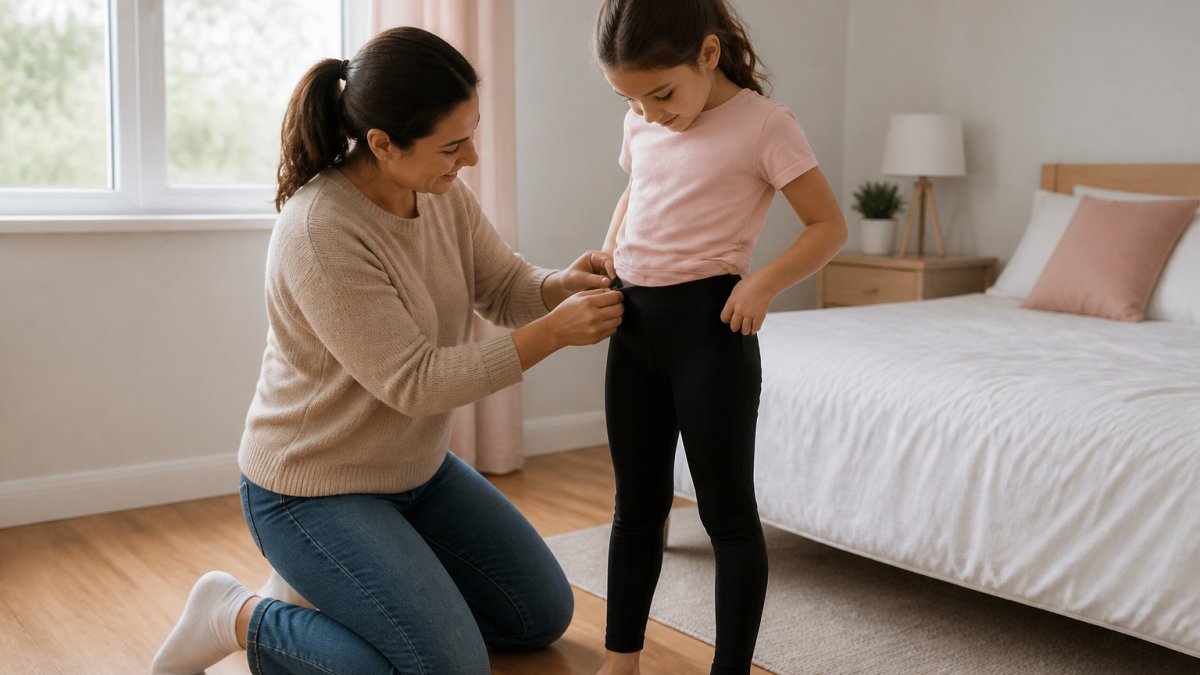
Take Three Measurements
Use a soft tape measure and keep it snug but not tight against the body:
- Waist: Measure around the narrowest part of her torso, usually just above the belly button. Have her stand relaxed and breathe normally.
- Hip: Measure around the fullest part of her seat, keeping the tape level all the way around.
- Inseam: Measure from the crotch seam down the inside of her leg to the ankle bone. For capri length, stop at mid-calf.
Write these numbers down and recheck them every few months. A common pattern is that waist and hip measurements change faster than inseam during growth spurts, which is why a pair that still fits at the waist may start feeling short in the leg.
Account for Growth Without Buying Too Big
Leggings should fit comfortably on day one, not require rolling the waistband or bunching at the ankle. A practical rule many parents use is to buy the size that matches her current measurements, then size up only when the chart shows she is between sizes or when the fabric has limited stretch. Leaving two inches of room in the waist is usually enough; more than that tends to sag during play.
Check the size chart for a regular versus slim fit. Slim fits usually narrow the waist and hip without shortening the inseam, which suits leaner children who find regular sizes gap at the waist. Regular fits offer more room through the hip and seat. If she is between a regular and slim fit, choose based on where the leggings feel loose: a gaping waistband points to slim, while tightness through the hip points to regular.
Check the Fit on Her, Not Just the Chart
Once the leggings arrive, have her sit, squat, and bend forward. The waistband should stay in place without digging in, the seat should not pull tight, and the ankles should not ride up past the ankle bone. If any of those happen, the size is wrong even if the chart said otherwise. Our stretch girls' leggings are cut to accommodate movement, but the measurements above remain the best way to choose between sizes.
Judging Durability and Preventing Holes
Durability is where many everyday leggings fail. Knees take the most wear, and seams and thin fabric can split after repeated washing and play.
Our Girls Pant - Leggings in a leopard print at $5.99 is a budget option.
How to Prevent Holes in Girls' Leggings
Holes usually come from friction, heat and rough washing rather than a single bad day. A few habits can extend the life of any pair:
- Wash in cold water on a gentle cycle, inside out.
- Skip the dryer when you can. Heat weakens elastic and stretchy fibers.
- Trim fingernails and toenails to reduce snags.
- Rotate pairs so one set does not take all the daily wear.
- Avoid rough surfaces, such as concrete, when she plays on the ground.
Pick Your Pair and Shop Girls' Leggings at Hot Possessions
Start with how she will wear them, check the fabric and opacity, measure carefully, and look for a pair built for regular washing and play. Our range of tween and toddler leggings is priced from $5.99 to $16.00.
When you are ready, browse the full selection of girls leggings and pick the pair that fits her week.
Frequently Asked Questions
What fabric is best for girls’ everyday leggings?
For everyday wear, a cotton-blend or soft stretch fabric is usually the most comfortable choice, since it breathes well and feels gentle on skin. Polyester or nylon blends handle sweat better and suit more active days. Check the fabric label before buying, and pick a blend that matches how much she moves and how often the pair will be washed.
How should girls’ leggings fit?
Girls’ leggings should sit snugly at the waist without digging in, and the legs should stretch comfortably without pulling tight at the knees. The fabric should move with her, not restrict her. Try a few movements such as squatting or sitting cross-legged to check that the waistband stays in place and the seams do not pinch.
How can you tell if leggings are too see-through?
Stretch the fabric over your hand or a light source. If you can see skin or the shape of your hand through it, the pair is likely too sheer for everyday wear. Darker solid colors and thicker knits generally provide better opacity. Holding the leggings up to a window before buying online is a simple home check when you receive them.
How do you choose the right size of leggings for a girl?
Start with her measurements, especially waist and inseam, and compare them to the brand’s size chart rather than relying on her age alone. Girls of the same age can vary widely in height and build. If she is between sizes, consider how much stretch the fabric has and whether she will grow into the pair during the season.