





Table of Contents
- Why Real Customer Photos Matter Online
- The Benefits of User-Generated Content for Ecommerce
- The Impact of Social Proof on Conversion Rates
- How to Increase Customer Photo Reviews
- How Real Customer Photos Reduce Returns and Sizing Doubts
- What to Look For in Customer Photos Before You Buy
- Frequently Asked Questions
Last Updated: September 15, 2026
Why Real Customer Photos Matter Online
Real customer photos are images of products taken and shared by actual buyers rather than professional studio shots, and they have become the single most trusted form of product information in online fashion. This guide explains why that shift happened, what it means for conversion, and how to evaluate customer photos before you buy.
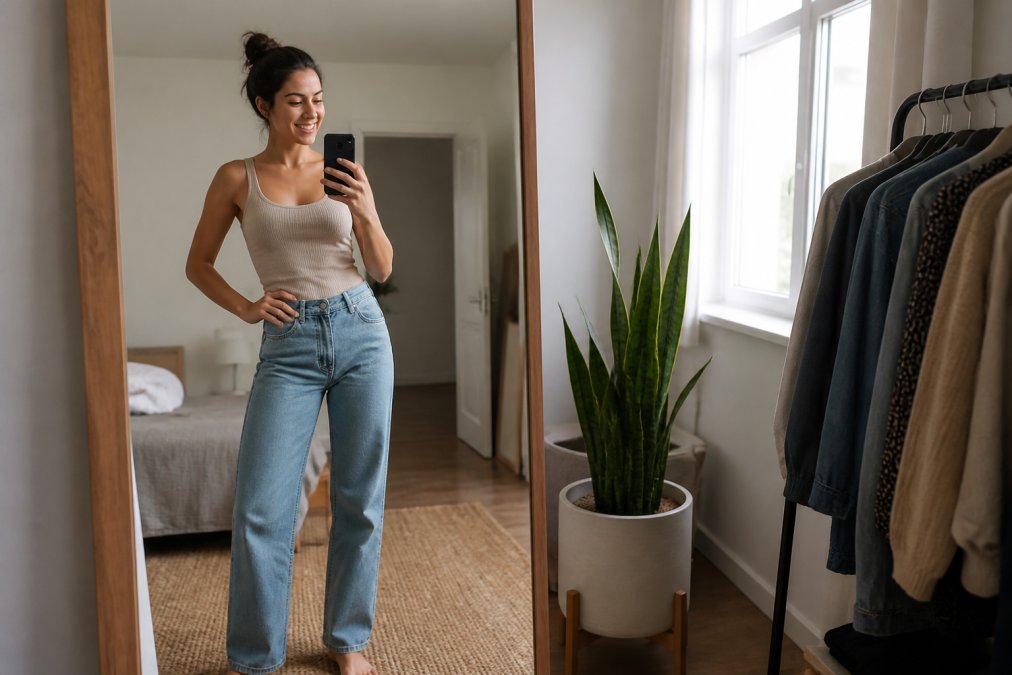
The reason is simple. A studio photo shows you what a garment looks like on a model under perfect lighting. A customer photo shows you what it looks like on a real body, in a real bedroom, under a real ceiling light. That difference changes buying decisions.
Below, we break down the benefits of user-generated content for ecommerce, how social proof affects conversion rates, and how to read customer photos like a seasoned online shopper.
The Benefits of User-Generated Content for Ecommerce
User-generated content is any photo, video, or review created by customers rather than the brand, and its primary benefit in fashion is closing the gap between expectation and reality. When a shopper sees a dress on five different body types, the guesswork shrinks.
The benefits stack up quickly:
- Fit verification across body types. One photo shows how a size medium drapes on a curvy frame; another shows it on someone tall.
- Color accuracy. Studio lighting flatters everything. Customer photos reveal what a "dusty rose" actually looks like in daylight.
- Fabric behavior. You can see whether a fabric wrinkles, clings, or holds its shape after a wash.
- Styling ideas. Real buyers pair pieces in ways a catalog never would, which helps you imagine the item in your own wardrobe.
Encouraging this content can build a feedback loop: shoppers who see real photos may feel more confident, buy more often, and be more likely to post their own photos afterward.
FTC guidance on endorsements and testimonials is worth understanding here, because it governs how brands can present and disclose customer reviews and photos. When you see a brand clearly labeling sponsored or incentivized content, that transparency is a good sign.
The Impact of Social Proof on Conversion Rates
Social proof is the psychological principle that people copy the actions of others when deciding what to do, and in online retail it is one of the strongest levers a store has. A product page with visible customer photos converts better than an identical page without them, because the photos function as evidence (Nov. E-Commerce Update Sites With Highest Conversion Rates).
Practical experience in ecommerce suggests that pages with photo reviews may keep shoppers on the page longer, and longer engagement can correlate with higher purchase completion. The mechanism is trust. A shopper who cannot touch the fabric relies on someone else's eyes.
Some brands collect reviews but bury them at the bottom of the page, or they display only star ratings without images. A five-star rating with no photo is a claim. A five-star rating with three customer photos can be more persuasive.
How to Increase Customer Photo Reviews
An effective way to increase customer photo reviews is to ask at the right moment, make posting effortless, and offer a small incentive that respects the customer's honesty. Timing can be very important.
The right moment is shortly after delivery, when the item is new and excitement is high. A request that arrives three weeks later usually gets ignored.
To make photo reviews easier to collect:
- Ask in the post-delivery email. A single line inviting a photo works better than a formal survey.
- Offer a modest incentive. A discount on a future order is standard and effective, as long as the incentive never requires a positive review.
- Make upload simple. A direct photo upload button beats asking customers to email images.
- Show examples. When shoppers see how others photograph items, they copy the behavior.
- Feature the best ones. When a customer sees their photo on the product page, they often post again.
Gating reviews behind a complicated account login can reduce participation. Minimizing steps can be beneficial.
How Real Customer Photos Reduce Returns and Sizing Doubts
Sizing doubt is a significant reason online apparel gets returned, and customer photos can be a direct antidote (Sizing returns in fashion and what causes them). When a shopper sees the same garment on someone with a similar build, the size decision becomes concrete instead of theoretical.
Consider what happens without photos. A shopper reads "runs true to size," orders a large, and hopes. If it arrives too small, the return costs everyone: the shopper's time, the retailer's shipping, and the shopper's willingness to buy again.
With photos, the shopper can compare:
| What You See | What It Tells You | How It Reduces Returns |
|---|---|---|
| Photo on a similar body type | How the cut drapes | Fewer wrong-size orders |
| Photo in natural light | True color | Fewer "not as pictured" returns |
| Photo after washing | Fabric durability | Fewer quality complaints |
| Photo with height noted | Length and proportion | Better length expectations |
This is also where flexible payment options matter. If you use a service like Afterpay or Klarna, confirm the store's return policy before you commit, because a returned item still needs to be handled according to that policy.
What to Look For in Customer Photos Before You Buy
Evaluating customer photos is a skill, and it takes about thirty seconds per product once you know what to check. Start with volume: a product with dozens of photos has been bought and worn by many people, which itself is a signal.
Then check these specifics:
- Variety of body types. If every photo shows the same build, the sample may be unrepresentative.
- Natural lighting. Photos taken near a window show true color better than flash photos.
- Multiple angles. Front, back, and side views reveal fit that a single pose hides.
- Honest captions. Reviewers who mention flaws are more credible than ones who praise everything.
- Recency. Recent photos reflect current inventory and current fabric.
At Hot Possessions & Glitter Girls, we carry over 4,000 apparel items across women's, juniors', and girls' sizing. Our new arrivals are added daily, and our product pages are built so you can find fresh styles without scrolling through the entire catalog.
Shopping online for clothes carries an unavoidable risk: you cannot try before you buy. That risk shrinks dramatically when real customer photos are part of the decision. Look for variety, natural light, honest captions, and reviews that state height and size, and you will make far fewer returns.
At Hot Possessions & Glitter Girls, we make that easier with over 4,000 items across women's, juniors', and girls' sizes, free shipping on orders over $99, and flexible payment through Afterpay, Klarna, and similar options. Browse the new arrivals, check the customer photos, and get started with Hot Possessions & Glitter Girls to shop with confidence.
Frequently Asked Questions
How do customer photos influence online purchase decisions?
Customer photos give shoppers a realistic view of how clothing fits, drapes, and looks on different body types. Professional studio images show garments under ideal lighting and styling, but real customer photos reveal what the item actually looks like when it arrives. This reduces uncertainty and helps buyers feel confident that what they see is what they will get.
Why is user-generated content more trustworthy than professional photography?
User-generated content comes from people who have purchased the product. Professional photos are often styled and edited for marketing purposes. When shoppers see real customer photos, they may trust that the images reflect genuine experiences, which can give user-generated content more weight than polished brand imagery.
How can real customer photos reduce return rates for online boutiques?
Returns often happen because the item looked different online than in person. Customer photos show real fit, fabric texture, and color in everyday lighting. When shoppers see those images before buying, they set more accurate expectations. Fewer surprises mean fewer returns, which saves both the shopper and the retailer time and money.
How do I encourage customers to share photos of their purchases?
Offer a small incentive like a discount code on the next order, make photo uploads easy on product pages, and feature customer photos prominently on your site and social channels. Sending a friendly follow-up email after delivery that asks for a quick photo also works well. When customers see their photos featured, they feel valued and are more likely to share again.