




Table of Contents
- Why Plus Size Clothing Fits Differently Across Brands
- How to Measure for Plus Size Clothing at Home
- Understanding Vanity Sizing in Plus Size Fashion
- Tips for Buying Plus Size Clothes Online
- Straight, Extended, and Plus Sizes: What's the Difference?
- Quick-Reference Size Conversion Chart
- Reading Customer Reviews and Photos for Fit Insights
- Alteration Hacks and Sustainable Sourcing for Plus Sizes
- Frequently Asked Questions
Last Updated: September 14, 2026
Why Plus Size Clothing Fits Differently Across Brands
Finding true plus sizes starts with one uncomfortable fact: the number on the tag is a suggestion, not a standard. No US law forces a 2X from one label to match a 2X from another, so the same label can fit like a completely different size, which explains most fit frustration.
This guide from Hot Possessions & Glitter Girls covers the measurements, conversions, and shopping habits that take the guesswork out of ordering, how to measure, how to read a size chart, and which details predict whether a garment will work on your body.
Fit varies for three structural reasons:
- Vanity sizing drift. Brands loosen their own scales to flatter shoppers, so a modern size 16 is roomier than one from a decade ago.
- Different fit models. Patterns are drafted around one body, so if your proportions differ, the same label sits differently on you.
- Fabric behavior. Two garments with identical measurements behave nothing alike once stretch enters the picture.
The FTC's guidance on textile and apparel labeling governs what must appear on a care label, but it does not mandate a universal size scale. That omission is the root of the problem.
How to Measure for Plus Size Clothing at Home
To measure for plus size clothing accurately, use a soft tape over thin clothing, keep it level and snug but not tight, and record every number in inches. Recheck twice; a half-inch error compounds into a garment that pulls or gapes.
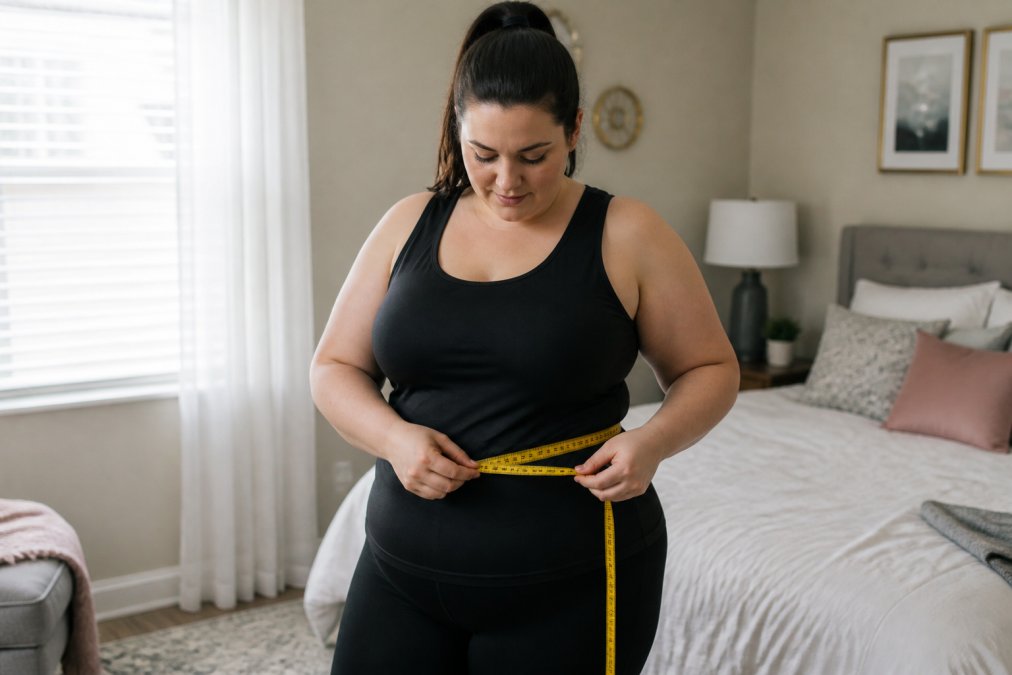
Work through these in order:
- Bust circumference. Wrap the tape around the fullest part of your bust, keeping it parallel to the floor.
- Natural waist. Find the narrowest point of your torso, usually just above the navel, and measure there without sucking in.
- Hips. Measure around the fullest part of your hips and seat, typically 7 to 9 inches below the waist.
- Inseam length. Measure from the crotch seam down the inside of the leg to where you want the hem to fall.
- Rise measurement. Measure from the crotch seam up to your natural waistline to judge where a waistband will sit.
A common mistake is measuring over bulky clothing or pulling the tape tight to force a smaller number; the tape should rest against the body, not compress it. If your bust and hips land in different size brackets, order the larger and plan a tailoring adjustment at the smaller.
Understanding Vanity Sizing in Plus Size Fashion
Vanity sizing means labeling garments with smaller numbers than their measurements warrant, so a body that once wore a 20 can now buy a 16. It flatters the shopper and muddies consistent sizing across brands.
A size 18 from one label may match a 16 from another and a 20 from a third, which is why a conversion chart is a starting point rather than an answer. Vanity sizing also hits plus ranges hardest, because brands expand their scales at different rates at the top end.
Tips for Buying Plus Size Clothes Online
The best approach to buying plus size clothes online is to treat the size chart as the primary source of truth and your usual size as secondary: measure first, match your numbers to the chart, and only then consider the label.
Start with the garment's flat measurements, not the body chart. A body chart tells you what the brand assumes a 2X body measures; a garment measurement tells you what the actual 2X piece measures laid flat. If a top lists a 46-inch bust flat and you measure 46 inches, you get zero ease, fine for a fitted knit, tight for a woven button-down, where you typically want 2 to 4 inches of ease.
Read the fabric composition before the size. Stretch percentage is the single most predictive number on a listing, and most shoppers skip it. As a working rule:
- 4% or more spandex (or elastane) blended into a knit usually means the garment recovers well and forgives a half-inch of variance.
- 1-3% spandex gives modest give, good for denim and structured knits, less forgiving in the waist.
- 0% stretch (rigid cotton, linen, most wovens) means the size chart is a hard boundary. Order to your largest measurement or size up.
A 95% cotton / 5% spandex jersey behaves nothing like a 100% cotton poplin, even when both carry the same 2X label.
Use the fit finder, but verify it. Many retailers offer a fit quiz that maps your measurements and brand history to a recommended size. These are useful starting points, but only as good as the data behind them, a brand with limited plus-size order history may default you to a straight-size equivalent. Cross-check the recommendation against the garment's flat measurements.
Check the return window and shipping cost before ordering, especially on final sale. A generous return policy is worth more than a slightly lower price on a style you're unsure about. Note whether returns are free, require original packaging, or exclude final-sale items, many do.
Filter by measurements, not by your usual size. When a brand lets you filter or sort by bust, waist, or hip, use it. It surfaces styles drafted for your proportions rather than styles that happen to carry your label.
Look for a dedicated plus or extended line rather than a standard style graded up. A style drafted on a plus fit model has armholes, rise, and bust shaping built for a fuller figure; a straight-size style graded up often runs tight through the arms and short through the rise.
With over 4,000 apparel items and new on-trend fashion added daily, we also tag plus-size styles clearly.
| Shopping habit | What it prevents | Effort |
|---|---|---|
| Save measurements once | Guessing on every order | 5 minutes |
| Read fabric composition and stretch % | Fit surprises from rigid fabric | 1 minute |
| Compare garment flat measurements to body chart | Relying on the size label | 2 minutes |
| Check return window and shipping cost | Being stuck with a bad fit | 30 seconds |
| Verify fit-finder recommendations | Defaulting to a straight-size equivalent | 1 minute |
Straight, Extended, and Plus Sizes: What's the Difference?
Straight sizes run from roughly 0 to 16, extended sizes bridge 14 to 20, and plus sizes typically start at 18 and go up, though cutoffs shift by brand. The distinction matters because a graded-up straight size is not the same as a style drafted for a plus body.
Straight sizing is drafted around a standard fit model. Extended sizing grades a straight-size pattern up, adding width but often keeping the original proportions. Plus sizing is drafted from the start around a plus fit model, so armholes, rise, and bust shaping account for a fuller figure.
The practical difference shows up in construction: a graded-up straight size often runs tight through the arms and short through the rise, while a true plus pattern allows ease where a fuller body needs it. When an "inclusive" line is just extended sizing, the fit can still feel off even when the label says plus.
Quick-Reference Size Conversion Chart
Use this table as a starting point, then confirm against the specific brand's own chart, because conversions are approximate and vary by label.
| Size label | Numeric range | Bust (in) | Waist (in) | Hip (in) |
|---|---|---|---|---|
| 1X | 14-16 | 42-44 | 35-37 | 44-46 |
| 2X | 18-20 | 46-48 | 39-41 | 48-50 |
| 3X | 22-24 | 50-52 | 43-45 | 52-54 |
| 4X | 26-28 | 54-56 | 47-49 | 56-58 |
These ranges are a navigation aid, not a guarantee. The NIST handbook on body measurement standards documents how body measurement data is collected for sizing research, and it confirms what shoppers already suspect: there is no single enforced scale across the apparel industry. Treat the chart as a map, and the brand's own numbers as the destination.
Reading Customer Reviews and Photos for Fit Insights
Customer reviews are the most underused tool in online shopping, and the most useful reviews mention height, usual size, and what the shopper actually ordered. A review that says "I'm 5'9", normally a 2X, and the 2X fit perfectly" tells you more than any star rating.
How to mine reviews for fit:
- Search the review section for your size and height before reading anything else.
- Prioritize reviews with photos, since they show how the garment drapes on a real body.
- Note whether reviewers say the item runs small, true to size, or large, and look for a pattern across several reviews.
- Ignore reviews that only mention color or shipping; they say nothing about fit.
If a style has no reviews, ask customer service for the garment's flat measurements before ordering.
Alteration Hacks and Sustainable Sourcing for Plus Sizes
A garment that fits 90% of the way is a tailoring job, not a return. A few small adjustments can rescue a piece that misses at the waist or hem, and cost far less than replacing it.
Start with the cheapest fix first. Before you thread a needle, try these no-sew adjustments:
- Add a belt to define the waist on a tunic or loose top. A wide belt over a long cardigan or dress changes the silhouette without altering the garment.
- Use fashion tape to secure a gaping neckline or a wrap that won't stay closed. It's removable, reversible, and cheap.
- Layer strategically, a fitted camisole under a too-low neckline, or a structured blazer over a boxy top, can solve a fit problem without touching the garment.
When you're ready to sew (or pay a tailor):
- Take in the waist on a dress or jumpsuit with two small darts at the back, the highest-return alteration for plus sizes, because waist-to-hip ratio varies more than any other measurement.
- Hem the length on a maxi or wide-leg piece rather than returning it for being too long. A blind hem preserves the original finish; a tailor typically charges less for a straight hem than for a structural alteration.
- Shorten the straps on a romper or jumpsuit to lift the bust and fix a gaping neckline. This is a five-minute fix with a needle and thread.
- Let out a seam where a garment allows it. Many plus-size garments include a generous seam allowance so a tailor can add an inch or two at the side seams.
A useful rule of thumb: if an alteration costs more than a third of the garment's price, it's usually not worth it unless the piece is a staple you'll wear weekly. Otherwise, return it.
On the sourcing side, sustainability in plus sizes is still catching up. Many ethical brands cap their range at a straight 16, shutting out a large share of shoppers. Look for specifics rather than slogans:
- Named certifications, look for third-party verification such as OEKO-TEX, GOTS, or Fair Trade Certified rather than vague "eco-friendly" language.
- Published size ranges, a brand that lists its full size run, including plus, is more credible than one that says "inclusive" without numbers.
- Fabric transparency, brands that name their mills or fiber sources are easier to verify than those that don't.
- Repair and resale programs, some brands offer repair services or take-back programs, which extend a garment's life and reduce textile waste.
The EPA's guidance on textile waste and sustainable materials offers useful context on why fabric choice and garment longevity matter as much as the label. Buying pieces you'll actually wear and keep, rather than returning them, is its own form of sustainability, and it's the one form of conscious consumption that doesn't require a brand to change its size range first.
Frequently Asked Questions
How do I determine my true plus size?
Start by taking fresh measurements with a soft measuring tape over light clothing. Record your bust, waist, and hip circumferences, then compare them to each brand's specific size chart. Because there is no universal standard, your true plus size can vary by 1-2 sizes between labels. Always size up if you are between sizes, and check the fabric stretch percentage to see how much give the garment has.
Why do plus size clothes fit differently across brands?
Fit differences come from inconsistent size labeling, varying garment ease, and different target body proportions. Some brands design for a curvier hip-to-waist ratio, while others use straighter patterns. Fabric composition also matters: a 95% cotton / 5% spandex blend stretches more than 100% polyester. This is why reading each brand's size chart and customer feedback is critical before buying.
What is the difference between straight, extended, and plus sizes?
Straight sizes typically run from 0 to 14 and follow a standard Misses fit. Extended sizes bridge the gap, often covering 14W to 18W with adjusted proportions for curves. Plus sizes generally start at 18W or 1X and go up to 5X or beyond, with more room in the bust, waist, and hips. Knowing which category a brand uses helps you navigate size charts accurately.
How can I accurately measure myself for online clothing purchases?
Use a soft measuring tape and measure over your undergarments. Keep the tape snug but not tight. Measure your bust at the fullest point, your natural waist (the narrowest part of your torso), and your hips at the widest point. Write down each measurement in inches. If you are between sizes, use the larger measurement. Re-measure every few months, as body proportions can shift.
Are there standard measurements for plus size clothing?
No, there are no universal standard measurements for plus size clothing in the U.S. Each brand creates its own size chart, leading to size label inconsistency. Some brands follow ASTM guidelines loosely, but vanity sizing and design choices cause variance. Always rely on the specific brand's size chart and customer reviews rather than assuming a 2X is the same everywhere.
What should I look for in a brand's size chart?
Look for detailed measurements in inches for bust, waist, and hips, not just letter sizes. Check whether the chart includes garment ease (the difference between body and garment measurements). Note the fabric stretch percentage, as higher stretch means more forgiveness. Also read the return policy and customer photos to see how the garment fits on real body types.