





Table of Contents
- Why Accurate Measurements Matter for Online Shopping
- What You'll Need to Measure Clothing Size Accurately
- Step-by-Step: How to Measure Bust, Waist, and Hips
- Understanding Garment Ease and Fit for Different Styles
- Using Size Charts and Converting Between Brands
- Tips for Buying Plus Size Clothes Online With Confidence
- Common Measuring Mistakes and How to Avoid Them
- Final Thoughts on Finding Your Fit
- Frequently Asked Questions
Last Updated: September 4, 2026
Ordering clothes online should feel exciting, not like a gamble. Learning how to measure women clothing size accurately is the single most reliable way to eliminate that guesswork. At Hot Possessions & Glitter Girls, we see daily how correct measurements transform the shopping experience.
You do not need a tailor's expertise. With a flexible measuring tape and about five minutes, you can capture your body dimensions precisely. Below, we walk you through each step, explain why your "usual size" varies between brands, and share insider tips for buying plus size clothes online.
Why Accurate Measurements Matter for Online Shopping
The gap between your measurements and a brand's size chart is where most online shopping frustration begins. Accurate body measurements connect your unique shape to a garment's design.
Most returns happen because of a size discrepancy, not a quality issue (nrf.com). When you know your exact bust, waist, and hip measurements, you stop relying on generic labels like "small" or "large" and can compare your numbers against a brand's garment specifications before you click "buy."
What You'll Need to Measure Clothing Size Accurately
Before you start, gather a few simple items.
- A flexible measuring tape (the soft, cloth kind used for sewing)
- Form-fitting clothing or thin undergarments
- A full-length mirror
- A pen and paper, or your phone for notes
- A friend or family member (optional, but helpful)
Wear minimal, close-fitting clothing so the tape rests against your actual body. Avoid measuring over jeans, sweaters, or shapewear, as these add inches that skew your results. Stand naturally with your feet together and posture relaxed.
Step-by-Step: How to Measure Bust, Waist, and Hips
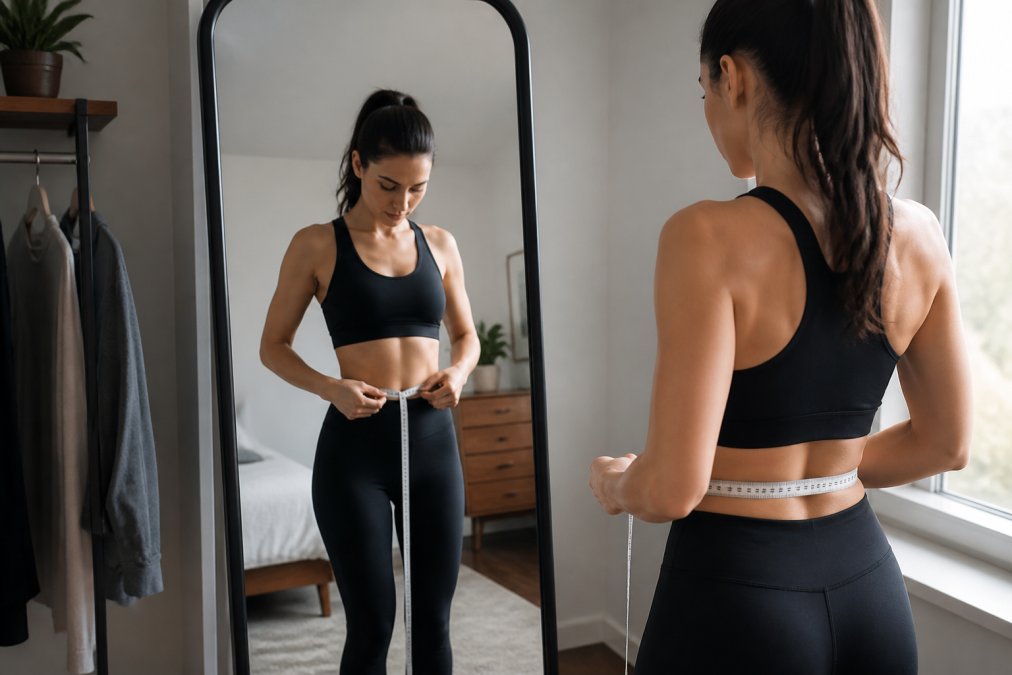
These three core measurements form the basis of most women's clothing sizes.
Step 1: Measure Your Bust Wrap the tape around the fullest part of your chest, keeping it level across your shoulder blades and under your arms. The tape should sit flat against your skin without digging in. Keep your arms relaxed at your sides and breathe normally. Record the number where the tape overlaps.
Step 2: Measure Your Waist Your natural waistline is the narrowest part of your torso, usually about an inch above your belly button. Bend to one side, and the crease that forms is your natural waist. Wrap the tape around this point, keeping it horizontal and snug but not tight. This measurement reflects where most skirts, high-rise pants, and fitted dresses will sit.
Step 3: Measure Your Hips Stand with your feet together and measure around the fullest part of your hips and bottom, typically seven to nine inches below your natural waistline. Keep the tape level all the way around. This hip measurement is critical for dresses, skirts, and pants, as it determines how fabric drapes over your lower body.
Understanding Garment Ease and Fit for Different Styles
Your body measurements are the starting point, not the final answer. Garment ease refers to the extra room a designer builds into a piece beyond your body dimensions, creating the difference between a bodycon dress and an oversized blazer.
How Ease Interacts with Body Shape
Most size charts assume your bust, waist, and hip measurements increase in relative proportion. If your body doesn't follow that pattern, and most don't, here is how to adapt based on your dominant shape:
- Pear Shape (Hips wider than bust): Your hip measurement will likely dictate your size in dresses, skirts, and pants. When a garment fits your hips but gaps at the waist, look for styles with darts or a defined waistband. For fitted tops, you can often size down to match your bust.
- Apple Shape (Waist fuller than hips or bust): Your waist measurement is the critical number. Avoid stiff, unforgiving waistbands; look for stretch, drawstrings, or empire waists. When your waist is one size and your hips another, choose the size that fits your waist, taking in hip fabric is simple, but letting out a waistband rarely is.
- Hourglass Shape (Bust and hips similar, waist narrower): You will often find a garment fits your bust and hips but is loose at the waist, a cut issue, not a measuring error. Prioritize stretch, wrap silhouettes, or belts. For non-stretch garments like blazers or sheath dresses, buy for your bust and hips and plan for tailoring at the waist.
- Rectangle Shape (Bust, waist, and hips similar): You have the most flexibility with sizing. Your bust measurement often decides tops and dresses; your hip measurement guides bottoms. Since you have less waist definition, look for styles that create shape, such as peplum tops or high-waisted pants with a structured waistband.
Applying Ease to Specific Garment Types
The style of the item also changes which measurement matters most and how much ease you should expect:
- Dresses: For a fitted sheath dress, your bust and hip measurements are equally critical. For an A-line dress, the hip measurement is less important because the skirt flares out. For a wrap dress, your bust measurement is the primary driver, as the style relies on the wrap to adjust the waist.
- Pants: For high-rise pants, your natural waistline is the key number. For mid-rise or low-rise styles, your hip measurement and the distance from your waist to your hip (often called the "rise") matter more. If you have a longer torso, you may need a "tall" inseam or a brand that offers extended rise lengths.
- Tops and Blazers: Your bust and shoulder width take priority. If you have broader shoulders, you may need to size up in fitted tops to avoid pulling across the back, even if your bust measurement falls into a smaller size. Check the garment's shoulder-to-shoulder measurement on the size chart if it is provided.
Using Size Charts and Converting Between Brands
Size charts are only useful when you know how to read them. Standardized sizing does not exist across the fashion industry, which is why a size 8 in one label might fit like a size 6 in another (nist.gov). Even when two brands use the same size label, their garment measurements can differ by two inches or more.
How to Read a Size Chart Like a Pro
Most size charts list body measurements, not garment measurements. A chart that says "Size M fits bust 36-38 inches" tells you what body size the garment is designed for, not that the garment itself measures 38 inches around.
To use a size chart correctly, follow this process:
- Find your three core measurements (bust, waist, hips) and write them down.
- Compare each measurement to the chart's ranges. If your bust fits a medium but your hips fall into a large, you are between sizes.
- Decide which measurement to prioritize. For a dress, prioritize the bust and hip. For high-waisted pants, prioritize the waist. For a fitted top, prioritize the bust.
- Check the fabric content. If the garment has 5% or more spandex or elastane, it will stretch to accommodate a smaller size (ncsu.edu). If it is 100% cotton or linen, it will not give.
- Look for the garment's finished measurements. Some brands, particularly online boutiques, list the actual garment dimensions. This is the most reliable data point because it tells you exactly how big the item is.
What to Do When You Fall Between Two Sizes
Falling between sizes is the norm, not the exception. Here is how to handle it:
- If you are between sizes in a fitted, non-stretch garment: Size up. A garment that is too small will pull, wrinkle, and feel uncomfortable. A garment that is slightly large can often be taken in by a tailor for a modest fee.
- If you are between sizes in a stretchy knit: Size down if you prefer a closer fit, or size up if you prefer a relaxed look. The fabric's recovery will determine how it holds its shape.
- If you are between sizes in pants or jeans: Always size up for the waist. You can wear a belt to cinch a loose waist, but you cannot easily add fabric to a waistband that is too tight.
- If you are between sizes in a dress with a defined waist: Size up and plan to have the waist taken in. This is a simple alteration that most tailors can complete quickly.
A Practical Method for Converting Between Brands
Since no universal standard exists, track how different brands fit you:
- Create a simple spreadsheet or note on your phone with columns for: Date, Brand, Item Type, Size Ordered, Bust/Waist/Hip Measurements, and Fit Notes.
- After each purchase, record the brand's size chart measurements for the size you ordered. This creates a reference library over time.
- Note the fit outcome. Did it run true to size, small, or large? Was the waist loose but the hips snug? This qualitative data is just as valuable as the numbers.
- Before ordering from a new brand, check if they publish garment measurements. If they do, compare those numbers to the garments you already own that fit well. This is the most reliable way to predict fit.
Many online boutiques, including Hot Possessions & Glitter Girls, publish detailed garment measurements so you can compare before purchasing. Over time, your measurement log will become your most trusted shopping companion.
Tips for Buying Plus Size Clothes Online With Confidence
Shopping for plus size fashion online requires the same fundamentals, with a few extra considerations. Look for brands that list garment measurements for each size rather than just S, M, L, as this signals they understand the diversity of body shapes within plus sizing.
Pay attention to fabric content. Fabrics with spandex or elastane offer stretch and forgiveness, while rigid denim or woven cotton fits closer to the stated measurements.
Check customer reviews for fit notes. Shoppers often share whether an item runs small, large, or true to size, along with their own measurements.
Common Measuring Mistakes and How to Avoid Them
Even with good intentions, small errors can throw off your numbers. The most frequent mistake is pulling the tape too tight, which compresses the body and produces a smaller measurement than reality.
Another common error is measuring over bulky clothing. A thick sweater or padded bra adds volume that does not reflect your true body dimensions.
Finally, avoid measuring at the wrong vertical point. The waist is not always where you wear your pants, and the hips are not at the widest part of your thigh.
| Mistake | How to Fix It | Impact on Fit |
|---|---|---|
| Tape pulled too tight | Keep it snug but not compressing | Garments arrive too large |
| Measuring over thick clothing | Wear fitted layers or underwear | Numbers skew larger than reality |
| Wrong waist location | Bend to find your natural crease | Pants and skirts sit incorrectly |
| Hips measured too low | Measure at the fullest point | Dresses feel tight through the seat |
Final Thoughts on Finding Your Fit
Mastering how to measure women clothing size accurately changes your entire relationship with online shopping. You move from hoping something fits to knowing it will, saving time, money, and frustration.
Keep your measurements written down and update them whenever your body changes. Pair those numbers with each brand's size chart, and you will find that most garments fit on the first try. For expert guidance, the team at Hot Possessions & Glitter Girls curates a collection of over 4,000 apparel items with detailed sizing information.
Frequently Asked Questions
Why do clothing sizes vary so much between different brands?
There is no standardized sizing system across the apparel industry. Each brand creates its own fit models and grading rules, which leads to size discrepancy. This is why measuring your body dimensions and comparing them to each brand's size chart matters more than the number on the tag. Vanity sizing also plays a role, where brands adjust measurements to make shoppers feel better about their size. Always rely on your tape measure, not your usual size, when ordering from a new retailer.
How much bigger should clothes be than your measurements?
This depends on the garment's intended fit and the amount of garment ease built into the design. For a form-fitting dress or bodysuit, the finished garment may be only 1-2 inches larger than your bust and hip measurement. For relaxed or oversized pieces, the difference can be 4-6 inches or more. The size chart should list the garment's actual measurements, not just your body measurements. Compare the two to decide if you want a snug, true-to-size, or loose fit.
Where exactly should I place the measuring tape for my bust, waist, and hips?
For your bust, wrap the tape around the fullest part of your chest, keeping it level across your shoulder blades. Your natural waistline is the narrowest part of your torso, usually about an inch above your belly button. For hips, measure around the fullest part of your bottom, typically 7-9 inches below your waist. Keep the tape snug but not tight, and make sure it stays horizontal all the way around. Taking these measurements in front of a mirror helps you check the tape position.
How can I determine my women's clothing size based on my measurements?
Once you have your bust, waist, and hip measurements, find the size chart for the specific item you want to buy. Match your largest measurement to the size column, since garments need to fit your widest point. For example, if your bust fits a medium but your hips measure as a large, order the large. Different clothing categories like dresses, jeans, and tops use different size standards, so always check the fit guide for that product rather than assuming your size stays the same across all items.
Finding clothes that fit well should never feel like a compromise. Start by measuring yourself once, keep those numbers handy, and let them guide every purchase you make. When you shop with Hot Possessions & Glitter Girls, you get access to a vast, constantly updated selection of women's, juniors', and girls' fashion, with free shipping on orders over $99 and flexible payment options through Afterpay, Klarna, and Zippay. Get started today and discover how easy it is to find your perfect fit.
This article was written using GrandRanker